| DNA discovered | Individuals and sole traders enabled to consider the social core of their proposed CIC’s on which to build their business model. Existing enterprises better able to envisage how their business will function and operate, giving them their business model. Seasoned business mind introduced to the DNA concept. Understanding social outcomes and their importance for the charity in formation. |
| Innovation | Continued development of STEP (Supported Transition Engagement Programme) as an outcome monitoring tool. The programme captures individuals’ soft skill development during volunteering or work experience opportunities, giving them a visual account for their own reflection, as well as a means for the enterprise to demonstrate outcomes they have enabled at a strategic level. 1 enterprise in particular we have worked in partnership with to develop this programme and 2 others have now also started using it and supporting further refinements. A planned development from STEP is the consideration of a work experience monitoring system, that enables visual representation of progression as well as the standard written form. 1 enterprise will be piloting this during 2023-34. Showing outcomes well to give more powerful media messages. Team project planning tools designed to meet enterprise ways of working, in particular to enable flexibility. |
| Connecting with customers | CIC’s understanding their purpose in delivering value to their customers,
understanding how to trade to meet customer needs, effective networking to connect with relevant customers, understanding the customer journey and how to engage with them, and revising communications to connect better. |
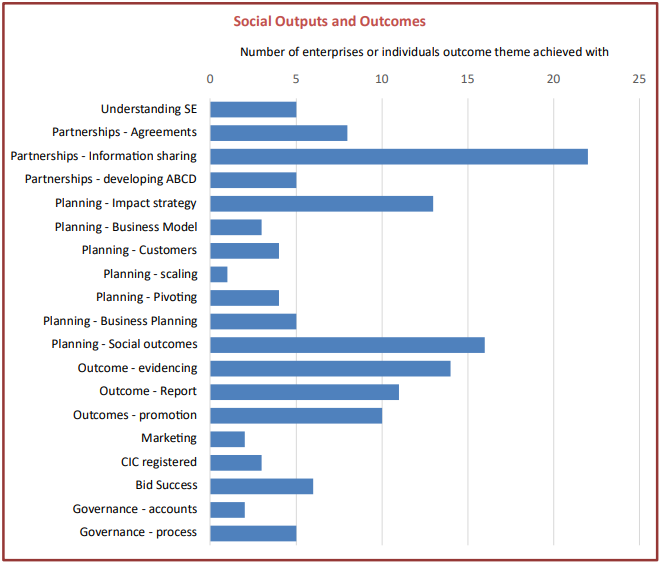
| Partnerships developed | Development of easy-to-use partnership agreements that identify strategic aim and objectives for collaborative pieces of work, giving consideration to social outcomes of the project embedded within the activity. Clear definition of partnership roles and focus for outcome monitoring, understanding social outcomes for individuals and businesses. Connecting enterprises together to share knowledge and resources to strengthen their work. |
| Project Monitoring to evidence social outcomes | Planning for social outcomes and project monitoring systems in place to ensure social impact recognised, evidenced and reported on for collaborative projects. Relevant monitoring systems in place with social outcomes connected to activities and individuals, with rolled up impact analysis at an organisational strategic level. Research project with incorporated Social Value Act outcomes able to evidence where the focus of future work needs to be. Social outcomes evidenced and analysed in line with business plan. Annual reports of social impact and media messaging more easily written and more powerful. |
| Building Enterprise DNA, Impact Strategy and Business Models | Understanding business DNA, the customer journey, partnership work, business modelling and planning. Understanding of planning to include social outcomes. Using DNA objectives to adapt promotional messages and to engage the interest of potential customers. Commercial business mind exploring social value. Updating business model and plan in line with new insights. |
| Support to find sustainable pathway at critical pivot points | Small businesses set up as limited companies exploring benefit of transitioning to become CICs. CIC set up with 2 purposes, one to support the other, enabled to evaluate business pathway and pivot to more manageable business model. |
| CICs set up and registered | Understanding the heart of the enterprise in order to support the set up the CIC. Building strategic foundations to CIC, including understanding business DNA and social outcomes. |
| Social outcomes and promotion | Refreshed outlook from an outside viewpoint on current plans and promotional material, ensuring social outcomes clearly demonstrated. Impact reports produced and publicised showing strong social impact. Development of the social impact mindset, changing approach to their work. Revising training course feedback in line with our recommendations to capture outcome evidence for the business plan. Clear view of the year’s work and outcomes achieved. |
| Developing an ABCD approach (Asset Based Community Development) | Adopting an ABCD approach, moving from identifying needs to recognising community strengths. Recognising how the enterprise can be sustainable through empowering the community. |
| Efficient governance | Reducing stress associated with maintaining financial records. Executive Boards understand their roles and responsibilities at a strategic level. Policies and procedures in place, being used appropriately. |